The Affordances of Parametric Images
by James Romberger
_______________________+________________________
My interest in visual perception stems from my activities as an artist, in particular as a draftsman. I wish to define the identification with, and immersion into, the linear image that the viewer has when looking at a spare outline drawing, the effect that is blocked when color is added. Additionally, I am an exponent of the art of creating comics and graphic novels, where visual and textual elements complement each other to impart narrative information. Little terminology exists for the analysis of the artwork�s function in comics, and literally none for the simultaneous perception of word and text that occurs in comics, or for the visual chasm fallen into by the reader when immersed in a narrative explicated by means of line drawings.
Classical artists such as Holbien and Ingres made exquisite purely linear drawings, but considered them to be preliminary works, exercises in visual problem-solving in the process towards a finished work in some other media. Some artists have made drawing their focus: Toulouse-Lautrec, Degas, Kollwitz. To talk about them critics might speak of composition and graceful execution and of the interaction between positive and negative space, but otherwise use the same terminology as for painting and graphic media. The art and literary worlds each have their own critical language. Today, graphic novels are being critiqued by literary reviewers who tend not to be also art critics, or to understand the unique blend of word and image in comics. They instead focus only on the value of the text. But, they do not have words to describe the world-building imagination of the artist who is able to simulate on paper with carefully placed lines a three-dimensional world, who is able to draw an invented reality from all angles, much less how this ability is applied to narrative thrust, page design and textual interaction.
_______________________+________________________
Areas relating to the mind�s perception of visual stimuli come under the blanket of Psychology. James J. Gibson (1904-1979) investigated the perceptual areas in question, and more, built on his findings to postulate a radical shift in how we perceive our world. Gibson worked with Cornell University and the U.S. Air Force in developing his theories. His use to the military was in his exploration of spatial perception, which is essential for human interaction with the rapidly developing capabilities of flight technology. In his 1951 paper �What is a Form?� Gibson tries to identify the cognitive processes involved in the interpretation of line drawings, and articulates problems when using them for clinical purposes. He writes, �The theories of visual form, on the whole, have on been based on evidence obtained with line drawings.� They have been widely used for clinical studies because of �the classical assumption that two-dimensional vision is immediate, primitive and sensory, while three dimensional vision is secondary, derived, or perceptual.� Gibson says it is the other way around, it is the world of representations that is learned.
Gibson defines pictures as carriers of optical information. Color hue and surface texture are processed as incoming red, green and blue light by the visual apparatus. Line art is perceived as light, but our apprehension of them occurs in part separately from color perception. The mechanism of this apprehension is unclear. according to Gibson: �The paper surface is scarcely seen and a different surface seems to emerge within the outline. The paper surface seems to become �back-ground� and to recede while the enclosed surface seems to take on �figural� qualities and to stand out� (1951). The drawing apparently projects from the page. In Gibson�s view, outlined pictures contain information, but do not replicate sensation. Line drawings show the outlines of the outer edges of forms rather than presenting a representation of the surface of form.
In the field of Psychology, purely outlined drawings are classified as �impoverished images,� i.e. having no surface and texture, as would be represented by color, tone and chiaroscuro. Color is bound up with texture in the perception of surface, so that drawn shadings and patterns create texture and become tonal, and a tonal drawing is perceived as contrasting grays. The visual phenomenon Gibson calls �standing out� is only present in line drawings.
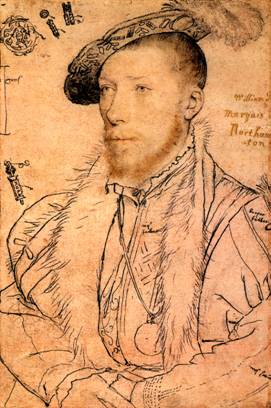
Figure 1: study by Hans Holbien the younger.
In Holbien�s drawing the color in the face interferes with the viewer�s immersion into the line. While seeming to represent the form in space more dimensionally, it acts to flatten the linear rendering surrounding it. Line drawings are �a representation or a substitute-object,� according to Gibson, �the ghosts of edges�projections of disembodied edges or symbols for ghostly abstractions�An outline form is ambiguous�in addition to being equivocal as a picture, it is a symbol for a bevy of geometrical ghosts... (it) consequently yields fluid, variable or inconsistent precepts�(1951). For these reasons, Gibson said line drawings were inappropriate for the purposes of psychological research. He goes on to focus his investigations on the visual perception of movement. This leads him to a revolutionary theory of perceptual science.
Twenty-eight years later, in �The Ecological Approach to Visual Perception,� Gibson lays out his controversial theory of �affordances.� In a sense, Gibson puts humans back into the center of the universe. Rather than concerning himself about cosmic distances or sub-microscopic particles, he envisions a more practical physics, in which the primary focus is about the life form in relation to the surfaces of its environment. The overall term affordances that Gibson coined describe preconditions for an animal�s interactivity with the surfaces in its proximity. �An affordance points both ways, to the environment and to the observer,� said Gibson. �An affordance is neither an objective property nor a subjective property, or it is both if you like� (1979). An object in space is only considered by what its surface layout or composition affords or offers the creature in terms of support. This affordance of support could be in the form of a chair that affords support because it is set at the height of the person that can then sit on it, or the form of informational representation on a paper platform, that is validated by a receptive viewer.
Harvard�s Ken Nakayama noted that Gibson avoids referring to internal processes of representation, but sees Gibson�s theories as relevant to their study: �the search for internal representation cannot proceed in isolation, divorced from behavior, or from an analysis of that which has to be represented� (1994). Both Nakayama and Stanford�s James G. Greeno have investigated facial recognition. Greeno writes, �in conversations, pauses, facial expressions, and other gestures provide information that influences the opportunities for each participant�s actions� (1994). In Greeno�s opinion, interactivity depends on recognition. Affordances may lie hidden in the parts of the mind connected to memory and learning. If the face is a support structure for information, then Gibson�s ideas translate to interpersonal dynamics. If one recognizes from an expression that someone is joking, or angry, they will respond accordingly. Individuals with more of a �repertoire� or comprehension of affordances in one area or another would have a more involved interaction with an affordance support structure.
The concept of affordances is then appropriate to describe the information in the form of the markings that make up the visual vocabulary of the artist, which are then applied to a support platform, and then ascribed varying degrees of representational acceptance by the viewer. Canvas and paper are support structures for representations in the form of drawings and paintings, which are given meaning by their layout and composition. The artist composes information about internal surface parameters into the design, the essential facts of the environment that is represented. The artist affords the platform information, and the viewer affords it representational validity. Affordances can be seen in this context as the contents of the visual library mutually implemented by viewer and artist. The artist can play with that library of parameters in the spaces between dimensions, and the viewer can appreciate the work more or less, depending on their receptivity to the visual cues.
An artist can subtly impart emotion or articulate classical values with the careful placement of a few lines, but it seems that an elegant line means nothing without a receptive sensibility to appreciate it.
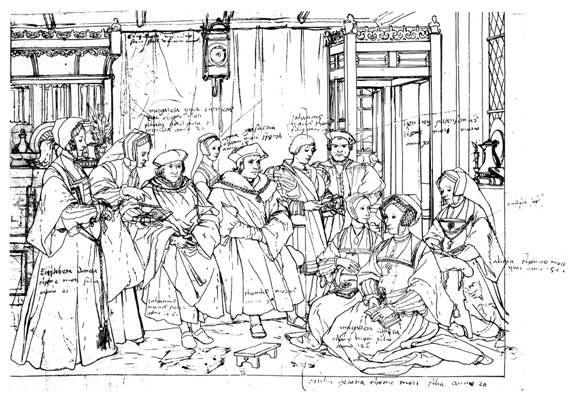
Figure 2: Thomas More family, Hans Holbien the younger, ink on paper c.1527. The final painting was destroyed by fire.
Holbien used tremendous skill in his rendering in order to afford us the specifics of this grouping, his lines placed just so to recreate a reality that seems as fresh today as when he drew it. His perspective is true, his drapery convincing, the individual characters exactly proportioned. The notations are yet more information Holbien afforded for himself, notes on color and other specifics to be applied to the finished color painting. Drawings can be layered and encoded with information about particulars in addition to spatial parameters and engage the representation of movement and time, for an extreme example this animation model sheet by cartoonist Alex Toth:
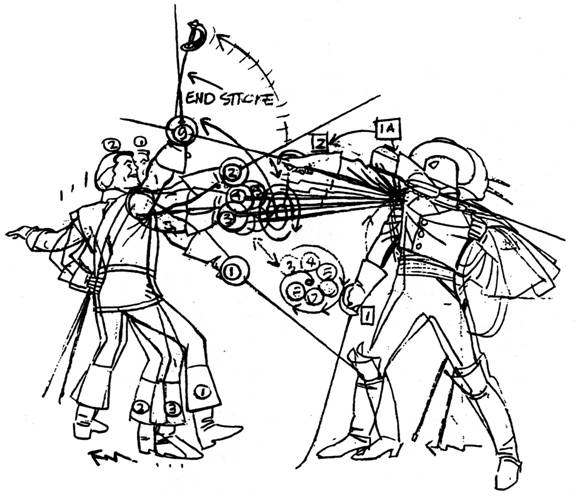
Figure 3: Alex Toth, model sheet for Hanna-Barbera cartoon of The Three Musketeers, 1968.
Toth�s animation drawings and comics are informed by research and observation. His drawing affords information about movement, time passage and proportion, to which an animator can afford recognition and extrapolate the joining actions of the swordfight. The animator is informed by the complex actions that Toth imbedded in the image and uses them in order to create another platform of affordances, moving onscreen.
Not everyone is equipped to comprehend these complicated affordances. Two- dimensional images are nearly universally recognized for their representational attributes, but there exceptions and variances in interpretation. Psychologist and Gibson expert Margaret A. Hagen relayed M. J. Herskovits� anecdote about a �Bush Negro� woman who could not see the likeness of her son in a photo or even recognize it as looking human, because her culture did not use flat representations (1974). A piece of paper with a single horizontal line, which actually will represent �horizon� to western viewers, might represent something else to someone from a culture not so recently oriented to seeing the world as flat.
_______________________+________________________
Having found at least some terminology and an entire worldview in my search for critical language to describe drawings, I find myself unsatisfied. Another trait of western mindset emerges when one considers that the terminology is bound up in capitalist culture. The term �affordance� implies value assigned by the artist and reciprocated by the viewer. The artist affords information and the viewer affords comprehension. So, I believe the widespread use of the term �impoverished� throughout the history of psychology to refer to line drawings is in need of reevaluation.[1] The word imposes a negative value judgement. In the context of art appreciation or a book review of comics drawn in line, the usage would imply a dearth of everything that should be there, but isn�t. Also, how is something impoverished composed of affordances, and how can those now-impoverished components be afforded image value? My first thought was that �economical� might be better to describe images that were pared-down to the essential, but that accepts evaluation. Words to describe color or otherwise textural images would then be enriched, affluent, or extravagant. In another possibility with admittedly negative connotations, an image that represents the color and texture of those surfaces might be called �explicit.�[2] Color images make afforded forms explicit as surfaces. The valuation inherent in the term �affordances� is essential to Gibson�s world view and well describes the arsenal of the artist. But the nothing-there of �impoverished� does not accurately describe line drawings, it merely indicates absence.
The word �parametric� might be useful to apply to images that describe the parameters of surfaces in space. �Parametric� indicates specificity and so accurately describes drawings. �Parametric images,� then, afford specific descriptions of the outside edges of things. This is why drawing is so often a prerequisite for the creation of paintings, drawing is purely composition. Once an artist has determined the parametric attributes of the space and the objects within that is being represented, the potential relative positions indicated by the invariant information can be extrapolated to simulate �observer motion� within the space. The moving observer of invariable affordances is Gibson�s main focus, and his concepts extend to account for an artist�s effort in comics, as well as in animation. In comics and animated cartoons the artist must often render their characters and settings from all conceivable viewpoints, acting as a camera moving around in created space. Both the artist and the eventual viewer must think in three dimensions, and extrapolate the elements which not visible within the image area. A set environment seen from multiple viewpoints necessarily includes overlapping of invariant elements within the parameters of the invented space when extrapolated from different angles. This is the �occlusion� speculated about by Gibson and succeeding researchers.
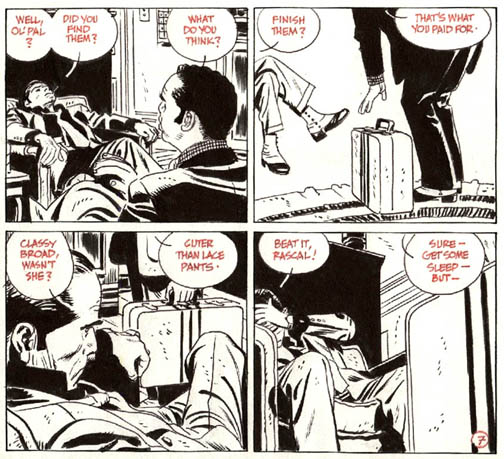
Figure 4: Alex Toth's motion perspective with subtly controlled affordances, from Torpedo.
Gibson noted that �changes in the optic array�could be understood as transformations in the sense of mapping, borrowing the term from projective geometry and topology. The invariants under transformation have been worked out� (1979). [3] The effective cartoonist possesses a skill-set that enables the mapping of the invariant qualities of the surface parameters of the desired environment and characters. Other skills are present in drawing and cartooning: �acting� in the layering of emotional signifiers in faces and gestures, dramatic staging and atmospherics, and those devices specific to comics regarding temporal progression, panel design and textual interrelation. These are also affordances, dependant on the artist�s knowledge and ability, and the audience�s recognition of the visual and textual structures.[4] The redefinition of �impoverished images� to the more accurate �parametric images� now correlates more comfortably with Gibson�s theory of affordances and establishes terminology that can be applied to the analysis of visual narrative that simulates observer motion. A controlled study of cartoonists might yield interesting information about observer motion and the affordances of visual perception.
_________________+_________________
Footnotes
[1] Negative connotations make this term anathema to usage in connection with fine art. A chic gallery would be hard-put to justify paying a huge overhead in rent and advertising budget to mount an exhibit of �impoverished drawings.� The term deluxuriates the art of drawing (although, that word reads as deluxe, another valuation).
[2] Explicit, rich, affluent, and extravagant all describe the state of the current Art world as represented by such artists as Jeff Koons and Damien Hirst, who work with materials of intrinsic value to create objects which are then traded are commodities in the high-end Art market.
[3] Gibson on observer motion and occlusion: �Some of the changes in the optic array are transformations of its nested forms, but the major changes are gain and loss of form, that is, increments of structure, as surfaces undergo occlusion. Proportions and cross-ratios underlie the transformations, however, and extrapolations, gradients, and horizon ratios underlie the increments and decrements.� (1979) This describes the process of drawing narrative continuity in comics.
[4] The terminology for the affordances offered by the viewer is not established. James G. Greeno suggested the word �ability,� as an alternative to R. E. Snow�s �aptitude.� These terms are in line with the concept that comprehension of linear affordances is enhanced by education. For the purposes of this paper, I have used the word �recognition� to approximate the viewer�s role in these complex interactions.
_________________+_________________
ReferencesHagen, Margaret A. Picture Perception: Toward a Theoretical Model. Psychological Bulletin.1974 Aug Vol 81(8) 471-497.
Hagen, Margaret A. James J. Gibson�s Ecological Approach to Visual perception. Koch, Sigmund (Ed); Leary, David E. (Ed). A century of psychology as science. (pp. 231-249). Washington, DC, US: American Psychological Association (1985, 1992) xiii, 1008 pp
Gibson, James J. What is a Form? Psychological Review. 1951 Nov Vol 58(6) 403-412.
Greeno, James G. Gibson's Affordances. Psychological Review. 1994 Apr Vol 101(2) 336-342.
Nakayama, Ken. James J. Gibson: An appreciation. Psychological Review. 1994 Apr Vol 101(2) 329-335.
Rader, Nancy de Villiers. Change and Variation in Responses to Perceptual Information.Dent-Read, Cathy (Ed); Zukow-Goldring, Patricia (Ed). Evolving explanations of development: Ecological approaches to organism-environment systems. (pp. 129- 157). Washington, DC, US: American Psychological Association (1997) xv, 601 pp
| Comic Art Forum | Ground Zero | 1xBet | Arteries |